
Generative AI: Predicting Value Through History


Introduction
Over the past decade, Large Language Models (LLMs) have gained notable popularity, driven by their potential to revolutionize diverse industries, including healthcare, education, and customer service. These AI models, developed to comprehend and generate human-like text, have shown remarkable advancement. For instance, OpenAI's GPT-3 boasts an impressive 175 billion machine learning parameters—a significant leap from the 1.5 billion parameters of its predecessor, GPT-2.
The burgeoning interest in LLMs is evident in the substantial increase in related preprints on arXiv, a repository for scientific paper preprints. These rose from 116 in 2018 to over 1,000 in 2022. ChatGPT became the fastest technical platform to amass 100 million users, accomplishing this feat in just two months. Furthermore, the surge in LLM-centric companies has drawn significant venture capital investment, with closed model enterprises like Cohere, Inflection, and Mistral AI each raising over $100 million.
Open vs. Closed Source Battle
Historian Henry Glassie once said, "History is not the past, but a map of the past, drawn from a particular point of view, to be useful to the modern traveler." His words inspired me to explore historical tech platform shifts to understand where value creation lies.
During the internet's nascent stages, various browsers competed for market share, leading to the well-known 'Browser Wars'—a scenario echoed today in the 'Generative AI battle.' Eventually, a few browsers, including the proprietary Internet Explorer, emerged as dominant players, primarily due to its integration with the Windows operating system. By 1999, Microsoft had captured 99% of the market, leading to antitrust litigation. Netscape's response was to open-source its codebase, giving birth to Mozilla, which subsequently developed and launched Firefox in 2002.
As an open-source project, Mozilla Firefox allowed for free code modification and contribution, leading to rapid innovation and a sense of community. This model contributed to reducing Internet Explorer’s market share to 50% by 2010, and Firefox is now the world's fourth most-used browser.
Following this trend, Google created Chrome by leveraging the open-source Chromium project. Despite Chrome itself not being fully open-source, its foundation on Chromium illustrates the crucial role of open-source projects in promoting innovation and product development. This successful model—employing open-source foundations and adding proprietary services or functionalities—led to Chrome's global dominance in browser market share.
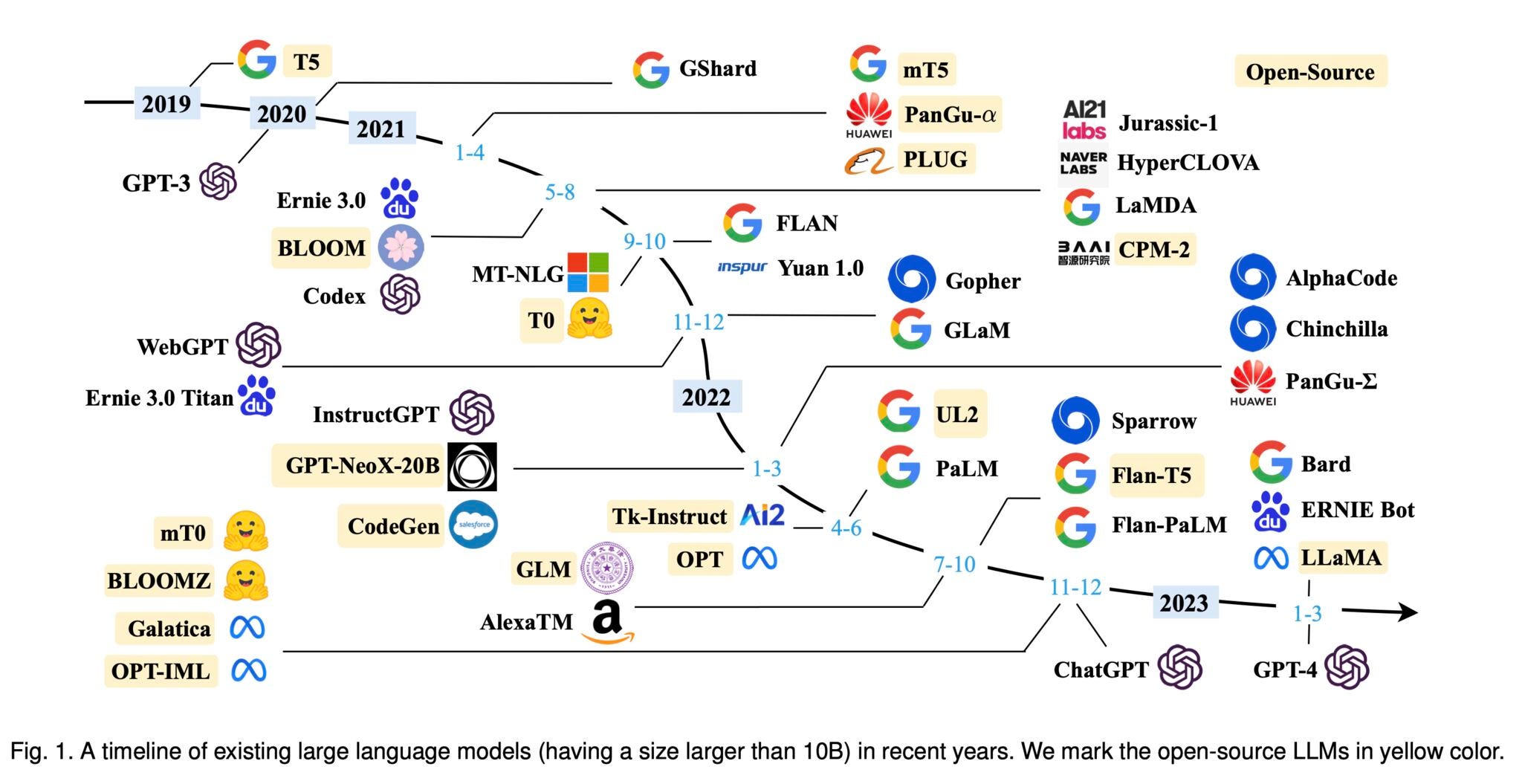
Source: https://arxiv.org/pdf/2303.18223.pdf
In the Large Language Model (LLM) space, a similar trajectory may unfold. Currently, there are numerous LLMs available, each with its own strengths and weaknesses. In the diagram above we can see the proliferation of models with an even spread of open vs. closed source builders. However, it's likely that only a few will emerge as the dominant players. These winning LLMs could be open source, fostering rapid innovation and enabling new business models.
The general rise of open-source software strengthens this notion. Initiatives like HuggingFace and the ability to train GPT-like models affordably (e.g., Colossal-AI open source code) underscore the potential of open-source LLMs. It's conceivable that the LLM space may mirror the transformative journey witnessed in the internet browser market.
Historical Value Opportunity: The Application Layer
However, tracing the historical map of platform shifts reveals that the true value of technological shifts often resides in the application layer built atop foundational technologies. During the internet's rise, technologies like browsers and servers were crucial, but substantial economic value was realized through applications like Amazon, Google, and Facebook. To illustrate, the combined market capitalization of these three companies alone exceeds $4 trillion as of 2023. Comparatively, Mozilla’s 2020 revenue was $497 million, with 88.8% derived from search deal royalties.
Likewise, as LLMs mature, a vast opportunity exists within the application layer built upon these foundational models. According to Grand View Research, the global AI market size is projected to grow at a compound annual growth rate (CAGR) of 40.2% from 2021 to 2028. A considerable part of this growth is expected to stem from the practical application of AI models like LLMs.
LLMs can be applied across industries—for automated customer service, content creation, personalized education, coding assistance, and more—offering a broad landscape for innovative applications.
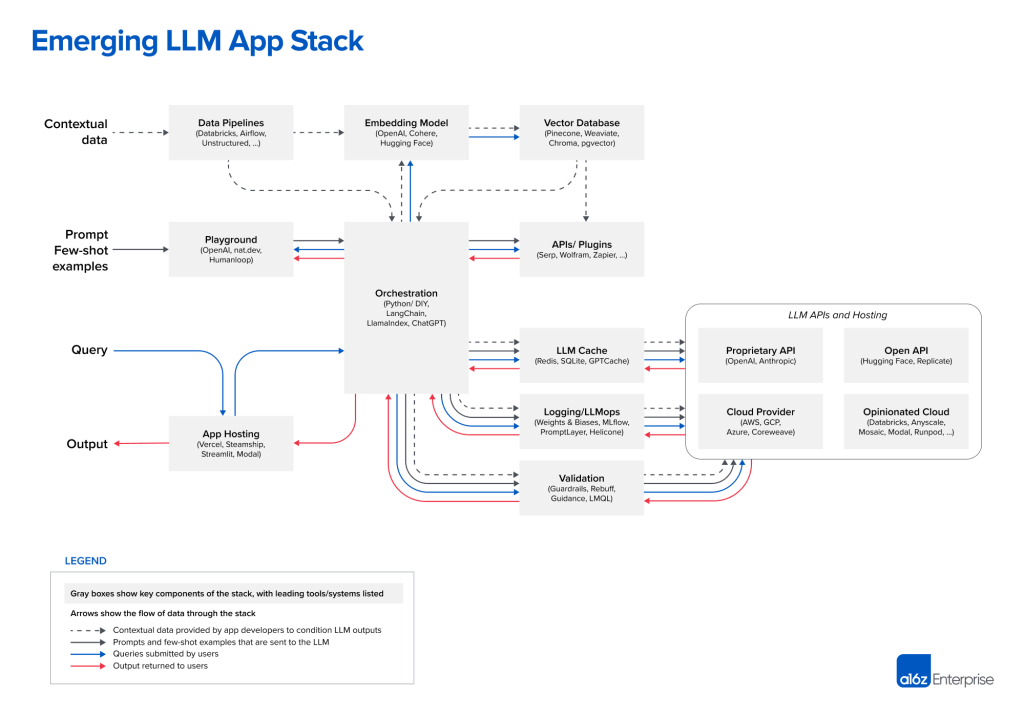
The emerging application ecosystem, as depicted in the diagram below from a16z Enterprise, confirms this trend. If history repeats itself, foundational models will be commoditized and the next generation of mega cap companies is likely to emerge from this application layer.
Conclusion
While foundational LLM models are vital and garner much attention, the substantial value opportunity for investors likely resides in the application layer built upon these foundational models. The potential for market growth in this space is significant. Standing on the precipice of this technological shift makes this an exciting time for venture capital investments in this field.